
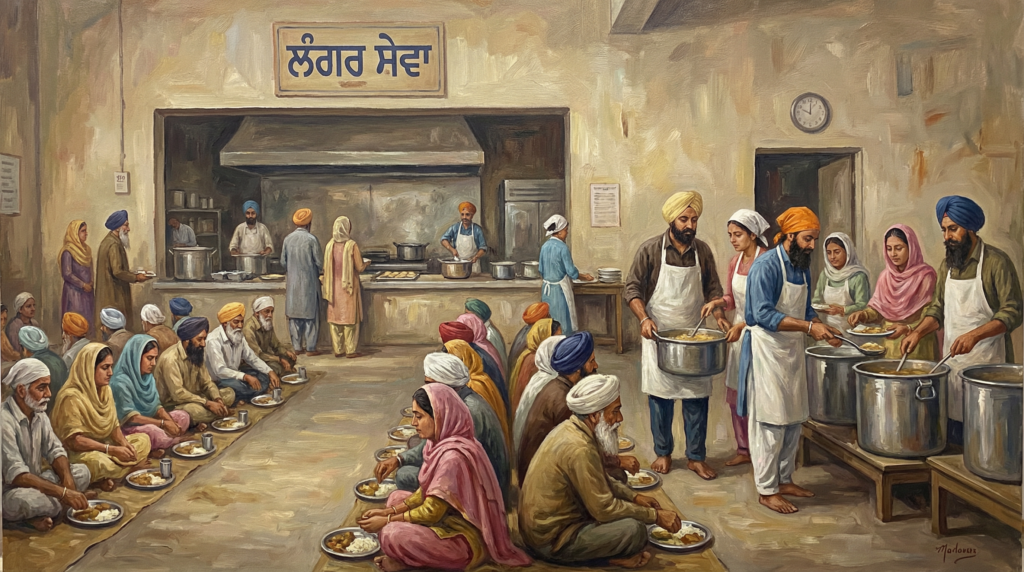
The Tradition of Langar: A Symbol of Equality and Service
One of the most profound and beautiful traditions in Sikhism is Langar—the community kitchen where free meals are served to everyone, regardless of religion, caste, color, or status. It is a living example of the Sikh principles of Vand Chakko (share what you earn) and Seva (selfless service).
The Origin: Sacha Sauda
The foundation of Langar was laid by Guru Nanak Dev Ji, the first Sikh Guru. As a young man, his father gave him 20 rupees to start a profitable business. Instead of buying goods for trade, Guru Nanak Dev Ji used the money to feed a group of hungry and homeless holy men. He called this the “Sacha Sauda” (The True Bargain).
Establishment and Evolution
The institution of Langar was further strengthened by Guru Angad Dev Ji and Guru Amar Das Ji. Guru Amar Das Ji made it a rule: “Pehle Pangat, Pichhe Sangat”—which means one must first sit in the rows of the Langar and eat together as equals before meeting the Guru.
Even the great Mughal Emperor Akbar had to sit on the floor and eat Langar with common people before he could meet Guru Amar Das Ji.
Core Principles of Langar
- Equality (Samatva): Everyone sits on the floor at the same level. There is no VIP seating.
- Selfless Service (Seva): The food is prepared, served, and the dishes are cleaned by volunteers (Sevadars) who seek no reward.
- Vegetarian Food: To ensure that people of all faiths and dietary restrictions can eat together, Langar is always strictly vegetarian.
- Open to All: No one is ever turned away from a Guru’s kitchen.
Langar Today: A Global Phenomenon
Today, Gurdwaras across the world serve millions of meals daily. From the Golden Temple in Amritsar, which feeds over 100,000 people every day, to Sikh volunteers providing food in war zones and during natural disasters, the spirit of Langar continues to inspire humanity.
Conclusion
Langar is not just about feeding the stomach; it is about feeding the soul with humility and love. It teaches us that in the eyes of the Creator, we are all one family.