
Vaisakhi History and Significance: The Birth of the Khalsa in 1699
Vaisakhi history and significance hold a special place in Sikh history and spirituality. Celebrated every year on April 13 or 14, Vaisakhi marks the harvest festival of Punjab and, more importantly, the historic day in 1699 when Guru Gobind Singh Ji established the Khalsa Panth at Anandpur Sahib.
For Sikhs around the world, Vaisakhi is not just a festival but a powerful symbol of courage, equality, and devotion to justice. The events of Vaisakhi 1699 transformed the Sikh community and laid the foundation for a distinct identity based on faith, discipline, and service.
The Historical Background of Vaisakhi
To understand the Vaisakhi history and significance, we must look at the political and social conditions of India in the late 17th century.
During that time, religious persecution was widespread under Mughal rule. The martyrdom of Guru Tegh Bahadur Ji, the ninth Sikh Guru, deeply impacted the Sikh community. He sacrificed his life to protect religious freedom.
After this sacrifice, his son Guru Gobind Singh Ji, the tenth Sikh Guru, realized that Sikhs needed both spiritual strength and the courage to defend justice. Vaisakhi became the moment when he would transform the Sikh community into a disciplined and fearless order.
Vaisakhi 1699 at Anandpur Sahib
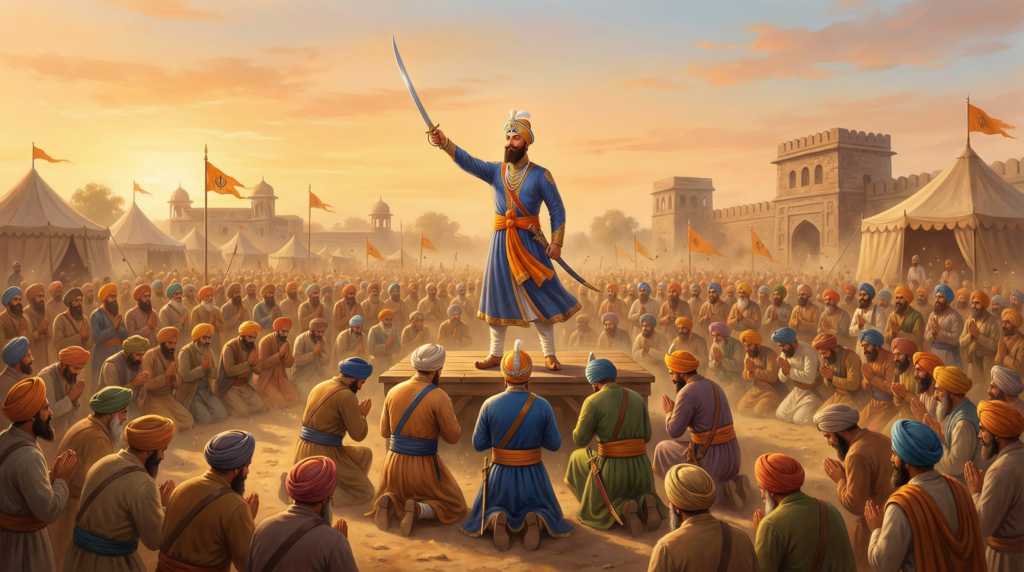
One of the most important moments in Vaisakhi history and significance occurred on April 13, 1699, at Anandpur Sahib.
Thousands of Sikhs gathered to celebrate the festival. Guru Gobind Singh Ji appeared before the crowd with a drawn sword and asked for a volunteer who was willing to sacrifice his life for faith.
The crowd fell silent.
Finally, a brave Sikh stepped forward. Guru Ji took him inside a tent. When Guru Ji returned with a sword appearing stained with blood, he again asked for another volunteer.
This happened five times.
The five volunteers who offered themselves became known as the Panj Pyare (The Five Beloved Ones).
They were:
- Bhai Daya Singh
- Bhai Dharam Singh
- Bhai Himmat Singh
- Bhai Mohkam Singh
- Bhai Sahib Singh
These five individuals came from different regions and castes, showing that the Khalsa would stand for equality and unity.
Creation of the Khalsa
After revealing the Panj Pyare alive, Guru Gobind Singh Ji prepared Amrit (holy nectar) by mixing water and sugar crystals in an iron bowl while reciting sacred prayers.
He then initiated the five volunteers into the Khalsa, the community of baptized Sikhs committed to a life of discipline, faith, and courage.
This event marks the true Vaisakhi history and significance, as it officially established the Khalsa Panth.
Guru Gobind Singh Ji then did something remarkable: he asked the Panj Pyare to initiate him as well. This showed that all members of the Khalsa were equal.
The Five K’s of the Khalsa
As part of the Khalsa identity, Guru Gobind Singh Ji instructed Sikhs to wear the Five K’s, which represent spiritual discipline and commitment.
The Five K’s include:
Kesh (Uncut Hair)
Symbolizes acceptance of God’s will.
Kangha (Wooden Comb)
Represents cleanliness and order.
Kara (Iron Bracelet)
Reminds Sikhs to act righteously.
Kachera (Cotton Shorts)
Represents moral discipline and self-control.
Kirpan (Sword)
Symbolizes courage and the duty to protect the weak.
These symbols remain essential to the Vaisakhi history and significance, representing the Sikh commitment to faith and justice.
Why Vaisakhi Matters Today
Even today, the Vaisakhi history and significance continue to inspire millions of Sikhs around the world.
The festival reminds Sikhs to live according to the principles of the Khalsa:
- Courage in the face of injustice
- Equality among all people
- Selfless service (Seva)
- Faith in one God
Across India, the United Kingdom, Canada, and many other countries, Sikhs celebrate Vaisakhi with Nagar Kirtans, community prayers, and Langar (free community meals).
These celebrations strengthen community bonds and keep the spirit of Vaisakhi alive.
Vaisakhi Celebrations Around the World
Modern Vaisakhi celebrations are vibrant and joyful.
Common traditions include:
- Visiting Gurdwaras for prayers
- Listening to Kirtan (devotional singing)
- Participating in Nagar Kirtan processions
- Serving Langar to everyone regardless of religion or background
These celebrations reflect the deeper Vaisakhi history and significance, reminding people of the values of unity, generosity, and faith.
Spiritual Significance of Vaisakhi
Beyond historical events, the Vaisakhi history and significance also carry deep spiritual meaning.
The creation of the Khalsa represented:
- The end of caste discrimination
- The empowerment of ordinary people
- The commitment to justice and truth
Guru Gobind Singh Ji envisioned the Khalsa as Saint-Soldiers (Sant-Sipahi) — individuals who combine spirituality with the courage to stand against oppression.
This philosophy continues to guide Sikh values today.
Conclusion
In conclusion, the Vaisakhi history and significance go far beyond a seasonal harvest celebration. Vaisakhi marks the birth of the Khalsa and a turning point in Sikh history that shaped the identity of Sikhs worldwide.
The courage of the Panj Pyare and the vision of Guru Gobind Singh Ji continue to inspire generations to live with faith, equality, and bravery.
Every year, Vaisakhi reminds the Sikh community of its powerful legacy — a legacy built on sacrifice, unity, and the unwavering defense of justice.